

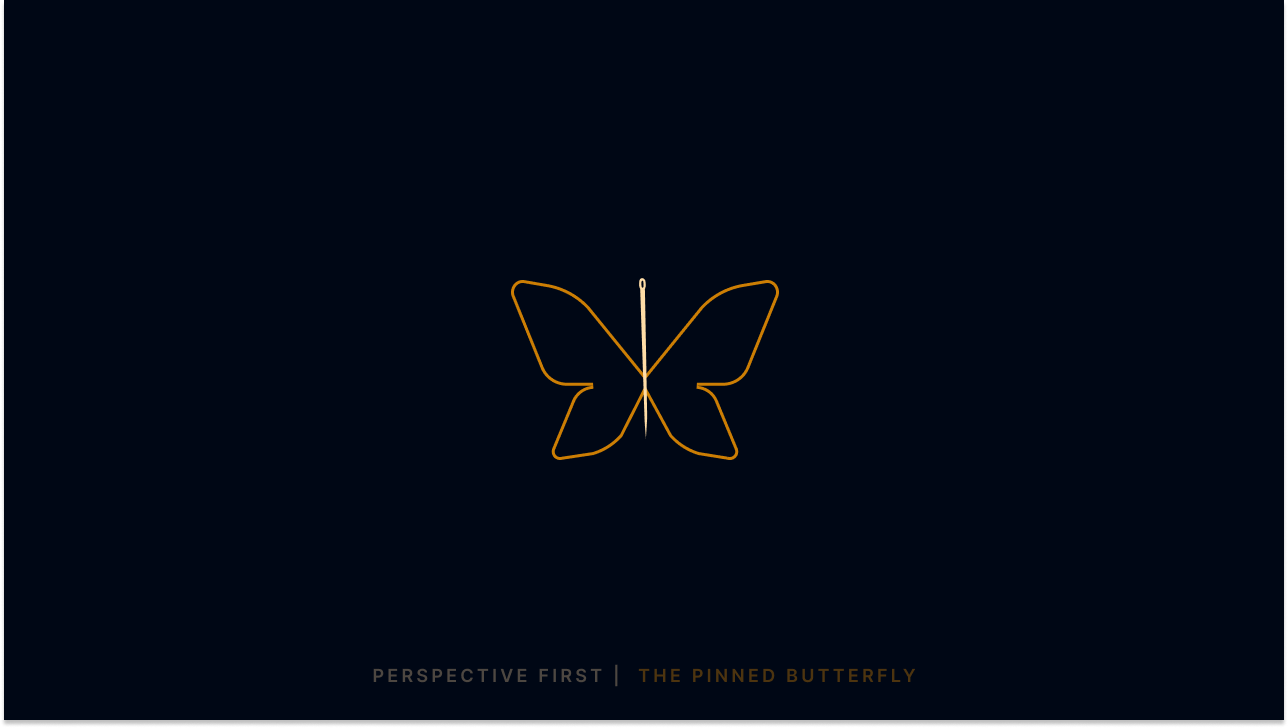
The Pinned Butterfly
You cannot understand a living thing. Only a dead one.

“The moment you teach a child the name of a bird, the child will never see that bird again.” — Jiddu Krishnamurti
You were five. Maybe six. A bird landed on the railing outside the kitchen window. You did not know what it was. You only knew the color — something between rust and fire. The way it tilted its head. The way it existed without explaining itself.
You pressed your face to the glass. Not to study. To be near.
Then someone behind you said: “That’s a robin.”
And the bird disappeared. Not from the railing. From your seeing. The word arrived and the living thing was filed. Robin. Category. Handled. The mind moved on. The glass was no longer pressed against.
The bird is still there. The child is gone.
This is the violence of understanding.
The mind approaches a living thing — a feeling, a person, a moment of inexplicable knowing — and reaches for its instruments. Analysis. Definition. Explanation. It pins the thing to a board. It dissects. It labels each part.
When it is finished, the mind believes it understands.
But the butterfly is dead. The mystery has been replaced by a file. The mind files a corpse and calls it knowledge. It holds a label and believes it holds the thing. It says “I understand” when it only means “I have stopped looking.”
Understanding is often where seeing goes to die.
You do this with people.
Someone you love says something that cuts. Before the sting has even reached your chest — before the heat arrives behind your eyes — the mind is already filing. They’re insecure. They’re projecting. That’s their attachment style.
The label lands. The filing is complete. And something in your shoulders releases — not because you have felt the moment, but because you have escaped it. The understanding became the anesthetic. The diagnosis replaced the contact.
You did not meet them in that moment. You classified them. And classification, no matter how accurate, is not intimacy. It is taxidermy.
You have done this to yourself, too. Sat with a therapist or a journal, named the pattern, filed the wound. And felt relief — not because something healed, but because something was handled.
The mind wants to understand so it can stop feeling.
Christopher Nolan was asked whether he worried audiences would not understand his film. He answered: “Don’t try to understand it. Feel it.”
This is not anti-intellectualism. It is precision.
Some things are not meant to be understood. They are meant to be felt. The explanation is not the deepening — it is the escape. The mind reaches for analysis because feeling is too direct, too uncontrolled, too alive.
There is another way to know.
Not comprehension. Recognition. Not grasping. Receiving. Not pinning. Witnessing.
The child before the name knew the bird this way. The knowing was complete. Nothing needed to be added. The contact was the knowledge.
Then language arrived. And with it, the long forgetting.
You cannot erase the names. They are permanent residents now. But you can stop mistaking the label for the thing. You can hold the word loosely enough that the living thing shows through again.
The mind will resist. It wants certainty before it will rest. It wants to file before it will feel. Not-knowing feels like falling. Like losing grip.
But not-knowing is not ignorance.
It is the space where the living thing can land without being pinned.
The bird is still out there. The same one you saw before the word. Before the file. Before the glass became a screen instead of a window.
It was never waiting for you to understand it.
You saw the bird once — before you knew its name. You called it color. Movement. Mystery.
That was not the lesser knowing. That was the only knowing there ever was.
— Perspective First
Understanding creates distance. Feeling requires closeness